
AI Can Build an App in a Week. So Why Do You Still Need a Software Company?
What the week-one app is missing, when you can ship it yourself, and when a software team still earns its fee.
Published: By Logicspice Team5 min read
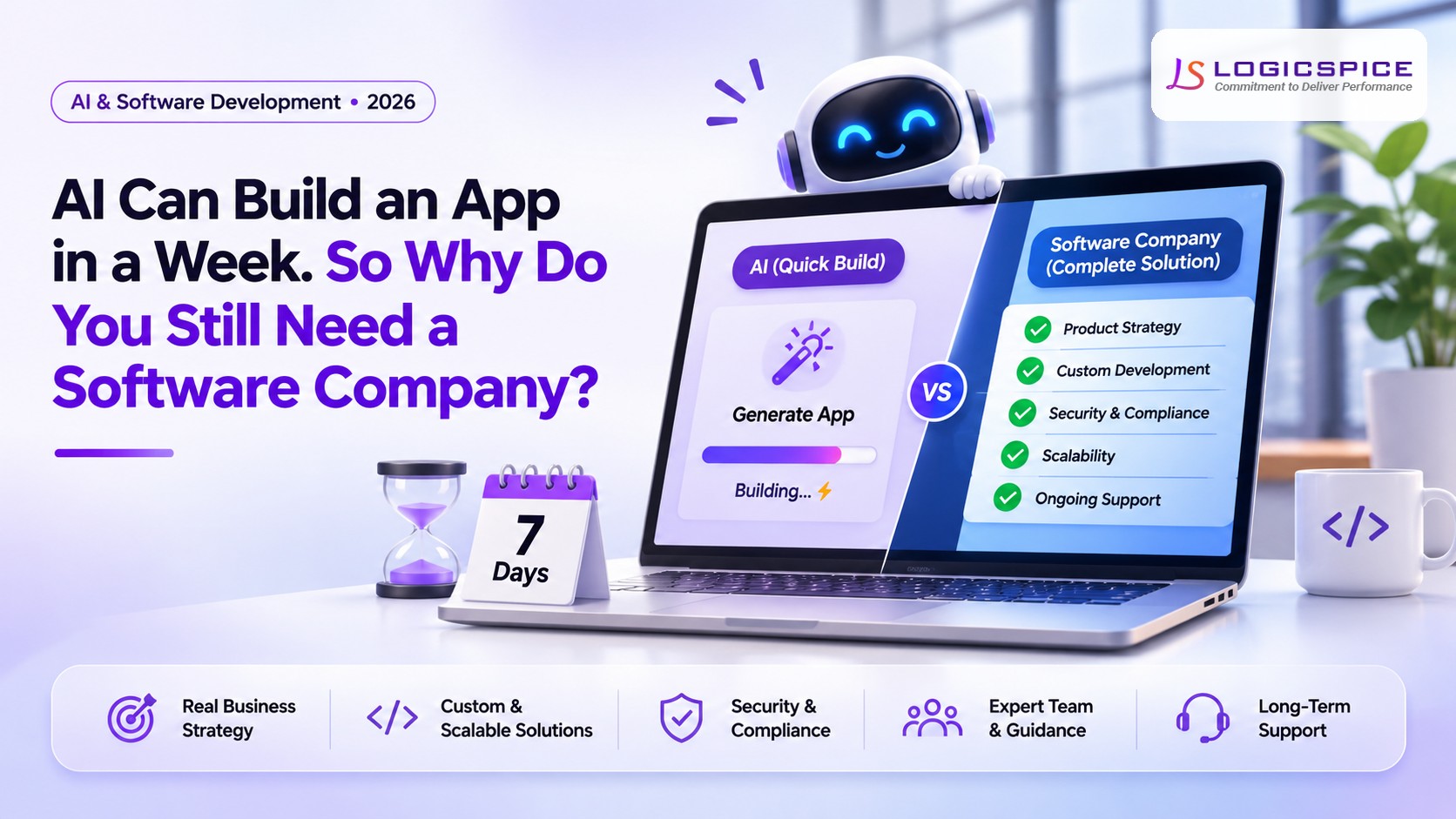
"If AI can build my app in a week, why would I pay you for three months?"
We hear this question in almost every first call now, and it is a fair one. Our answer: AI has made building the first version cheap, and it has not made owning a product cheap. You no longer pay a software company to type code. You pay it to be responsible for what the code does once real users, real data and real money are involved.
First, the claim is true
We will not pretend otherwise. Describe an idea to a modern AI app builder or coding agent and you can have a working app with screens, a database and a login within days. We use the same tools ourselves, every day.
For a founder testing an idea, this is the best thing to happen to software in a decade. A prototype that once cost months of budget now costs a weekend. If your goal is to show investors a demo or check whether ten customers care, build it with AI and do not call us yet.
A demo is not a product
The app AI builds in a week is the part you can see. The part you cannot see is what decides whether it survives contact with customers.
What AI builds in week one: screens and design, login, database, core features.
What a product still needs before real users arrive: security review, access rules, edge-case testing, load and scaling, payment flows, privacy compliance, monitoring, backups and support.
Nothing in the second list shows up in a demo, which is why it gets skipped. All of it shows up later, usually at the worst moment.
Where AI-built apps break
The evidence here is no longer anecdotal.
- 44% of AI code generation tasks introduced a known vulnerability in Veracode's 2026 testing.
- 56% security pass rate, against 55% in Veracode's first report.
- 18,697 user records exposed by one AI-built app in February 2026.
Security has not kept pace with speed. Veracode's 2026 testing found that about 44% of AI code generation tasks introduced a known vulnerability. The security pass rate was 56%, against 55% in its first report, so newer models write more code without writing safer code (Veracode).
Real apps have already leaked real data. In February 2026 a researcher found 16 vulnerabilities, six of them critical, in a single app built on an AI app-building platform. It exposed 18,697 user records. The cause was an access check written backwards: it blocked logged-in users and let anonymous ones in (The Register).
That last detail matters. The app looked finished and worked in every demo. The flaw was invisible to anyone who did not know to look for it, and that is the pattern: AI-built apps rarely fail on what you can see.
What you pay a software company for now
Writing code was never the hard part of software. Deciding what to build, and standing behind it afterwards, was. AI has removed most of the typing and left those two jobs untouched.
- Judgment before the first prompt. AI builds exactly what you ask for. It will not tell you that your payment flow breaks a local tax rule, or that the feature you want is the wrong one. A good team spends its first week asking questions, not generating code.
- Architecture that survives growth. An app that works for 50 users can fall over at 5,000. Choosing the data model, hosting and integrations so the product does not need a rewrite in month six is experience, and a prompt cannot supply it.
- Security and compliance someone signs off on. Access rules, encryption, backups, audit logs, privacy law. An AI tool carries no liability when these fail. A company with a contract does.
- Testing for the cases nobody demoed. The demo shows the happy path. Production is the expired card, the double tap, the user on a slow phone, the import file with 40,000 rows.
- Someone who answers at 2 a.m. Software is never finished. Operating systems update, APIs change, a bug appears on a holiday. Ownership means a named team, a response time and a roadmap.
We use AI across all of this, and it makes us faster. That speed is why a project that took six months two years ago now takes far less. You should expect any software company to pass that saving on to you.
When you do not need us
An honest answer depends on what the app will hold and who will rely on it.
| Your situation | Build it yourself with AI | Bring in a software team |
|---|---|---|
| Purpose | Prototype, demo, internal tool | Product customers pay for |
| Users | You and a small team | The public, or other businesses |
| Data | Nothing sensitive | Personal, payment or health data |
| If it goes down for a day | Annoying | Lost revenue or lost trust |
| Integrations | One or two simple ones | Payments, ERP, third-party APIs |
| Lifespan | Weeks to months | Years |
| Regulation | None | Privacy, finance or sector rules |
If most of your answers sit in the first column, keep building. If even two or three sit in the second, the week-one app is a starting point and not the product.
Our position
AI can build an app in a week. It cannot yet be accountable for one. The companies that will struggle are the ones still charging for typing. The ones worth hiring use AI to build faster and spend the time saved on the parts that decide whether your product survives: the right decisions, security, reliability and long-term ownership.
So bring us your AI-built prototype. It is the best brief a client can give us. We will tell you plainly what is ready, what is risky, and what it takes to turn it into something your customers can trust.
Already built something with AI? Send it to us for a free review, and we will show you what stands between your demo and a launch.
Sources
- Veracode: 2026 GenAI Code Security Report (28 July 2026)
- The Register: Lovable-hosted app exposed 18K users (27 February 2026)